What Systems Actually Teach (Beyond What They Say)
Most systems present themselves as structured environments for learning. In practice, they teach through patterns of reinforcement rather than stated intention.
Insights
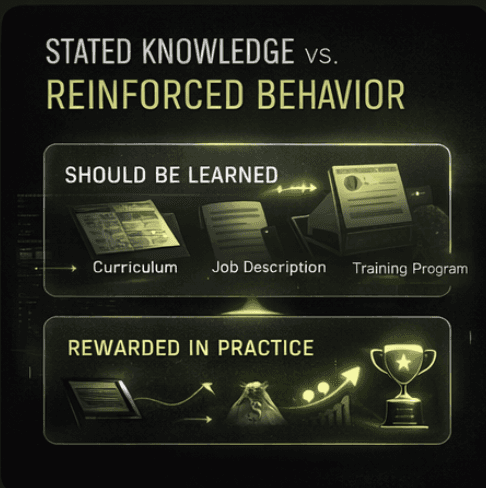
01. Stated Knowledge vs. Reinforced Behavior
Systems formally define knowledge through structured artifacts.
Curricula outline what students should understand. Job descriptions define what roles require. Training programs attempt to standardize competence.
On the surface, this creates clarity.
But in practice, individuals quickly learn that alignment with stated expectations is not what determines success.
Instead, success is shaped by what the system actually rewards:
Who gets promoted
Who is trusted with responsibility
Whose voice is taken seriously
This creates a divergence between what is taught and what is necessary to operate within the system.
Over time, individuals stop optimizing for correctness and begin optimizing for recognition and survival within the structure.

02. Repetition Becomes Instruction
Systems rarely need to explicitly teach behavior.
They only need to consistently reward it.
When a specific type of behavior leads to stability, advancement, or approval, it is repeated.
And through repetition, it becomes understood as “the right way.”
This is how informal rules are formed:
Not because they were written
But because they worked
Eventually, these patterns become indistinguishable from formal instruction.
People begin to internalize them as if they were always part of the system’s design.
In this way, behavioral patterns replace formal teaching as the primary source of learning.
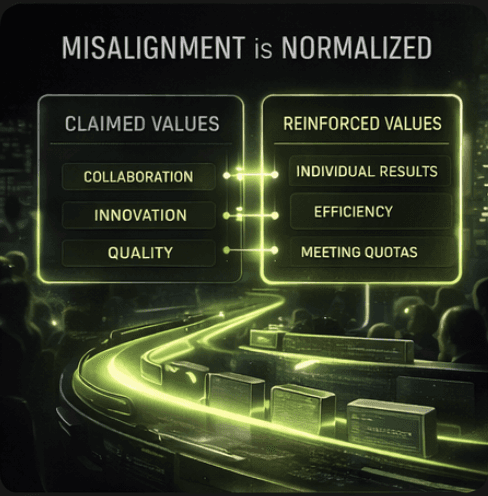
03. Misalignment Is Normalized
Most systems contain a gap between their stated values and their operational reality.
They may claim to value:
Innovation
Critical thinking
Equity
Expertise
But consistently reward:
Speed over depth
Familiarity over competence
Compliance over challenge
Initially, this misalignment is noticeable.
But over time, individuals adapt.
Not because they agree with it, but because adaptation becomes necessary for stability.
Eventually, the contradiction stops feeling like a problem and starts feeling like how things work.
This is the moment when the quiet curriculum becomes fully embedded.
Not when people notice it, but when they stop questioning it.
04. Visibility Determines Value
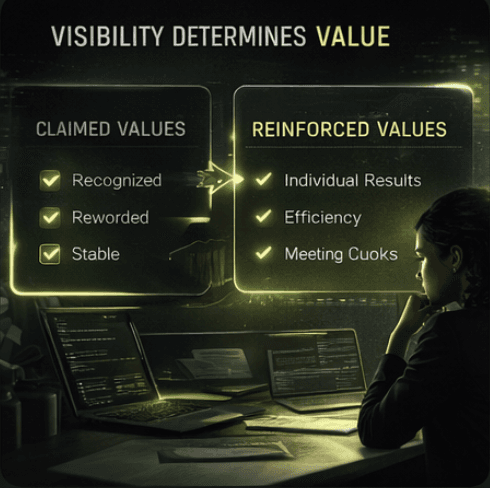
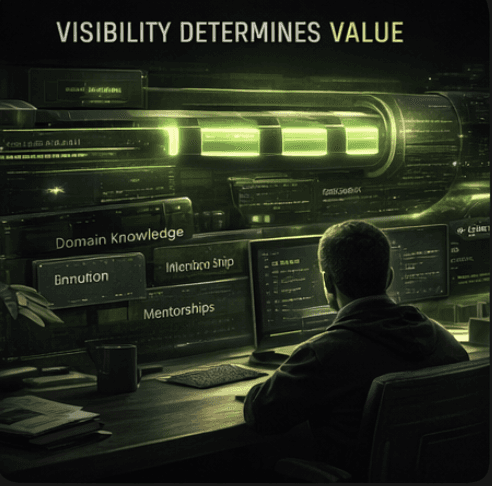
Systems prioritize what they can easily track.
Metrics, outputs, credentials, and surface-level indicators become proxies for value because they are:
Measurable
Comparable
Defensible
But not everything that matters is visible.
Deep understanding, long-term thinking, and nuanced skill development often exist outside of immediate measurement.
As a result:
What is visible becomes overvalued
What is invisible becomes neglected
This reshapes behavior.
Individuals begin to focus on what can be seen, documented, and validated, even if it does not reflect the full scope of their capability.
In this way, visibility becomes mistaken for value.
05. Learning Occurs Through Consequence
Systems do not need to explain what matters.
They demonstrate it through outcomes.
Every outcome sends a signal:
What gets rewarded is interpreted as correct
What gets ignored is interpreted as irrelevant
What gets penalized is avoided
This creates a feedback loop.
People adjust not based on instruction, but based on what leads to the least resistance and the most stability.
Over time, this reshapes decision-making at a fundamental level.
Individuals are no longer asking:
“What is right?”
They are asking:
“What works here?”
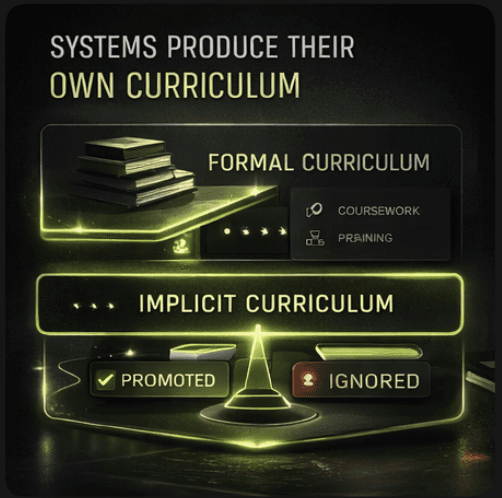
06. Systems Produce Their Own Curriculum
Beyond formal structures, every system generates a second layer of learning.
This is not written, but it is consistent.
It exists in:
Patterns of promotion
Informal expectations
Unspoken norms
Repeated outcomes
This is the quiet curriculum.
It determines:
What counts as expertise
Who is considered credible
How legitimacy is assigned
And unlike formal instruction, this curriculum is learned quickly, because it is reinforced daily.
Over time, it becomes the dominant framework through which individuals understand the system.
Implication
If learning is shaped more by reinforcement than instruction, then systems are not primarily teaching what they claim to teach.
They are teaching:
What to prioritize
What to ignore
What to tolerate
What to become in order to remain within them
Which means the most important question is not:
“What is this system designed to teach?”
But:
“What is this system designed to sustain?”
More to Discover
What Systems Actually Teach (Beyond What They Say)
Most systems present themselves as structured environments for learning. In practice, they teach through patterns of reinforcement rather than stated intention.
Insights
01. Stated Knowledge vs. Reinforced Behavior
Systems formally define knowledge through structured artifacts.
Curricula outline what students should understand. Job descriptions define what roles require. Training programs attempt to standardize competence.
On the surface, this creates clarity.
But in practice, individuals quickly learn that alignment with stated expectations is not what determines success.
Instead, success is shaped by what the system actually rewards:
Who gets promoted
Who is trusted with responsibility
Whose voice is taken seriously
This creates a divergence between what is taught and what is necessary to operate within the system.
Over time, individuals stop optimizing for correctness and begin optimizing for recognition and survival within the structure.
02. Repetition Becomes Instruction
Systems rarely need to explicitly teach behavior.
They only need to consistently reward it.
When a specific type of behavior leads to stability, advancement, or approval, it is repeated.
And through repetition, it becomes understood as “the right way.”
This is how informal rules are formed:
Not because they were written
But because they worked
Eventually, these patterns become indistinguishable from formal instruction.
People begin to internalize them as if they were always part of the system’s design.
In this way, behavioral patterns replace formal teaching as the primary source of learning.
03. Misalignment Is Normalized
Most systems contain a gap between their stated values and their operational reality.
They may claim to value:
Innovation
Critical thinking
Equity
Expertise
But consistently reward:
Speed over depth
Familiarity over competence
Compliance over challenge
Initially, this misalignment is noticeable.
But over time, individuals adapt.
Not because they agree with it, but because adaptation becomes necessary for stability.
Eventually, the contradiction stops feeling like a problem and starts feeling like how things work.
This is the moment when the quiet curriculum becomes fully embedded.
Not when people notice it, but when they stop questioning it.
04. Visibility Determines Value
Systems prioritize what they can easily track.
Metrics, outputs, credentials, and surface-level indicators become proxies for value because they are:
Measurable
Comparable
Defensible
But not everything that matters is visible.
Deep understanding, long-term thinking, and nuanced skill development often exist outside of immediate measurement.
As a result:
What is visible becomes overvalued
What is invisible becomes neglected
This reshapes behavior.
Individuals begin to focus on what can be seen, documented, and validated, even if it does not reflect the full scope of their capability.
In this way, visibility becomes mistaken for value.
05. Learning Occurs Through Consequence
Systems do not need to explain what matters.
They demonstrate it through outcomes.
Every outcome sends a signal:
What gets rewarded is interpreted as correct
What gets ignored is interpreted as irrelevant
What gets penalized is avoided
This creates a feedback loop.
People adjust not based on instruction, but based on what leads to the least resistance and the most stability.
Over time, this reshapes decision-making at a fundamental level.
Individuals are no longer asking:
“What is right?”
They are asking:
“What works here?”
06. Systems Produce Their Own Curriculum
Beyond formal structures, every system generates a second layer of learning.
This is not written, but it is consistent.
It exists in:
Patterns of promotion
Informal expectations
Unspoken norms
Repeated outcomes
This is the quiet curriculum.
It determines:
What counts as expertise
Who is considered credible
How legitimacy is assigned
And unlike formal instruction, this curriculum is learned quickly, because it is reinforced daily.
Over time, it becomes the dominant framework through which individuals understand the system.
Implication
If learning is shaped more by reinforcement than instruction, then systems are not primarily teaching what they claim to teach.
They are teaching:
What to prioritize
What to ignore
What to tolerate
What to become in order to remain within them
Which means the most important question is not:
“What is this system designed to teach?”
But:
“What is this system designed to sustain?”
More to Discover
What Systems Actually Teach (Beyond What They Say)
Most systems present themselves as structured environments for learning. In practice, they teach through patterns of reinforcement rather than stated intention.
Insights
01. Stated Knowledge vs. Reinforced Behavior
Systems formally define knowledge through structured artifacts.
Curricula outline what students should understand. Job descriptions define what roles require. Training programs attempt to standardize competence.
On the surface, this creates clarity.
But in practice, individuals quickly learn that alignment with stated expectations is not what determines success.
Instead, success is shaped by what the system actually rewards:
Who gets promoted
Who is trusted with responsibility
Whose voice is taken seriously
This creates a divergence between what is taught and what is necessary to operate within the system.
Over time, individuals stop optimizing for correctness and begin optimizing for recognition and survival within the structure.
02. Repetition Becomes Instruction
Systems rarely need to explicitly teach behavior.
They only need to consistently reward it.
When a specific type of behavior leads to stability, advancement, or approval, it is repeated.
And through repetition, it becomes understood as “the right way.”
This is how informal rules are formed:
Not because they were written
But because they worked
Eventually, these patterns become indistinguishable from formal instruction.
People begin to internalize them as if they were always part of the system’s design.
In this way, behavioral patterns replace formal teaching as the primary source of learning.
03. Misalignment Is Normalized
Most systems contain a gap between their stated values and their operational reality.
They may claim to value:
Innovation
Critical thinking
Equity
Expertise
But consistently reward:
Speed over depth
Familiarity over competence
Compliance over challenge
Initially, this misalignment is noticeable.
But over time, individuals adapt.
Not because they agree with it, but because adaptation becomes necessary for stability.
Eventually, the contradiction stops feeling like a problem and starts feeling like how things work.
This is the moment when the quiet curriculum becomes fully embedded.
Not when people notice it, but when they stop questioning it.
04. Visibility Determines Value
Systems prioritize what they can easily track.
Metrics, outputs, credentials, and surface-level indicators become proxies for value because they are:
Measurable
Comparable
Defensible
But not everything that matters is visible.
Deep understanding, long-term thinking, and nuanced skill development often exist outside of immediate measurement.
As a result:
What is visible becomes overvalued
What is invisible becomes neglected
This reshapes behavior.
Individuals begin to focus on what can be seen, documented, and validated, even if it does not reflect the full scope of their capability.
In this way, visibility becomes mistaken for value.
05. Learning Occurs Through Consequence
Systems do not need to explain what matters.
They demonstrate it through outcomes.
Every outcome sends a signal:
What gets rewarded is interpreted as correct
What gets ignored is interpreted as irrelevant
What gets penalized is avoided
This creates a feedback loop.
People adjust not based on instruction, but based on what leads to the least resistance and the most stability.
Over time, this reshapes decision-making at a fundamental level.
Individuals are no longer asking:
“What is right?”
They are asking:
“What works here?”
06. Systems Produce Their Own Curriculum
Beyond formal structures, every system generates a second layer of learning.
This is not written, but it is consistent.
It exists in:
Patterns of promotion
Informal expectations
Unspoken norms
Repeated outcomes
This is the quiet curriculum.
It determines:
What counts as expertise
Who is considered credible
How legitimacy is assigned
And unlike formal instruction, this curriculum is learned quickly, because it is reinforced daily.
Over time, it becomes the dominant framework through which individuals understand the system.
Implication
If learning is shaped more by reinforcement than instruction, then systems are not primarily teaching what they claim to teach.
They are teaching:
What to prioritize
What to ignore
What to tolerate
What to become in order to remain within them
Which means the most important question is not:
“What is this system designed to teach?”
But:
“What is this system designed to sustain?”