Uncredentialed: When Experience Becomes Invisible
Experience does not disappear when it goes unrecognized. It becomes invisible in systems that can only value what they are designed to interpret.
Insights

01. Recognition Requires Translation
Experience, on its own, is not inherently legible.
It exists as:
Context
Judgment
Pattern recognition
Situational awareness
But institutions do not evaluate raw experience directly.
They rely on interpretable formats.
Resumes, certifications, portfolios, and standardized signals act as translation layers.
Without translation, experience remains:
Unstructured
Difficult to verify
Hard to compare
So even when it is present, it is not recognized.
This means individuals are not just required to have experience.
They are required to encode it in a language the system understands.
02. Credentials Act as Shortcuts
Credentials are not proof of mastery.
They are signals of assumed competence.
They compress complex ideas into something instantly readable:
A degree suggests exposure
A title suggests responsibility
A certification suggests validation
This allows systems to move quickly.
Instead of asking, “What does this person actually know?”
They ask, “Do they match the signal we recognize?”
This is not necessarily about accuracy.
It is about efficiency at scale.
Credentials reduce uncertainty.
And systems are designed to prioritize certainty over depth.

03. Legibility Determines Value
In most systems, value is not assigned based on depth of knowledge.
It is assigned based on ease of interpretation.
What can be quickly understood becomes prioritized:
Clean career trajectories
Recognizable institutions
Standardized achievements
What cannot be easily interpreted becomes risky:
Nonlinear paths
Self-taught expertise
Context-heavy experience
Even when the latter reflects deeper capability.
This creates a distortion:
Simple signals are overvalued
Complex knowledge is undervalued
Not because one is better.
But because one is easier to read.
04. Experience Without Proof Is Treated as Absence
When experience cannot be verified within institutional frameworks, it is often disregarded.
Not challenged.
Not evaluated.
Simply excluded from consideration.
This creates a silent disconnect:
Individuals operate with real, applied knowledge
Systems operate as if that knowledge does not exist
This is where frustration emerges.
Because from the individual’s perspective, the issue is recognition.
But from the system’s perspective, the issue is lack of evidence.
So the burden shifts.
Not to develop more expertise,
but to prove what is already known in an acceptable format.

04. Experience Without Proof Is Treated as Absence
When experience cannot be verified within institutional frameworks, it is often disregarded.
Not challenged.
Not evaluated.
Simply excluded from consideration.
This creates a silent disconnect:
Individuals operate with real, applied knowledge
Systems operate as if that knowledge does not exist
This is where frustration emerges.
Because from the individual’s perspective, the issue is recognition.
But from the system’s perspective, the issue is lack of evidence.
So the burden shifts.
Not to develop more expertise,
but to prove what is already known in an acceptable format.

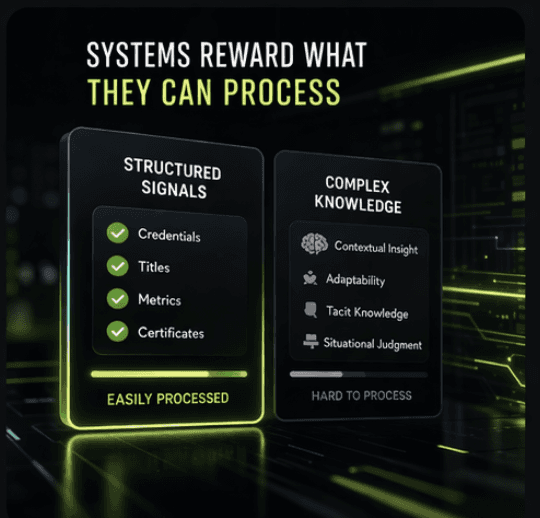
05. Systems Reward What They Can Process
Institutions are built to manage volume, risk, and consistency.
They are optimized for:
Speed
Standardization
Comparability
Not for:
Nuance
Context
Deep evaluation
As a result, they favor inputs that are:
Structured
Predictable
Easily categorized
This means knowledge that requires explanation, interpretation, or context is often deprioritized.
Not because it lacks value.
But because it slows the system down.
So the system rewards what it can process,
even if what it processes is only a partial representation of reality.
Implication
If recognition depends on legibility, then expertise without translation will remain unseen.
This reframes the problem.
The issue is not:
A lack of intelligence
A lack of experience
A lack of capability
The issue is structural unreadability.
Which means the real divide is not between:
Qualified and unqualified
But between:
Recognized and unrecognized
And those categories are not determined by what people know.
They are determined by what systems are able to interpret.

More to Discover
Uncredentialed: When Experience Becomes Invisible
Experience does not disappear when it goes unrecognized. It becomes invisible in systems that can only value what they are designed to interpret.
Insights
01. Recognition Requires Translation
Experience, on its own, is not inherently legible.
It exists as:
Context
Judgment
Pattern recognition
Situational awareness
But institutions do not evaluate raw experience directly.
They rely on interpretable formats.
Resumes, certifications, portfolios, and standardized signals act as translation layers.
Without translation, experience remains:
Unstructured
Difficult to verify
Hard to compare
So even when it is present, it is not recognized.
This means individuals are not just required to have experience.
They are required to encode it in a language the system understands.
02. Credentials Act as Shortcuts
Credentials are not proof of mastery.
They are signals of assumed competence.
They compress complex ideas into something instantly readable:
A degree suggests exposure
A title suggests responsibility
A certification suggests validation
This allows systems to move quickly.
Instead of asking, “What does this person actually know?”
They ask, “Do they match the signal we recognize?”
This is not necessarily about accuracy.
It is about efficiency at scale.
Credentials reduce uncertainty.
And systems are designed to prioritize certainty over depth.
03. Legibility Determines Value
In most systems, value is not assigned based on depth of knowledge.
It is assigned based on ease of interpretation.
What can be quickly understood becomes prioritized:
Clean career trajectories
Recognizable institutions
Standardized achievements
What cannot be easily interpreted becomes risky:
Nonlinear paths
Self-taught expertise
Context-heavy experience
Even when the latter reflects deeper capability.
This creates a distortion:
Simple signals are overvalued
Complex knowledge is undervalued
Not because one is better.
But because one is easier to read.
04. Experience Without Proof Is Treated as Absence
When experience cannot be verified within institutional frameworks, it is often disregarded.
Not challenged.
Not evaluated.
Simply excluded from consideration.
This creates a silent disconnect:
Individuals operate with real, applied knowledge
Systems operate as if that knowledge does not exist
This is where frustration emerges.
Because from the individual’s perspective, the issue is recognition.
But from the system’s perspective, the issue is lack of evidence.
So the burden shifts.
Not to develop more expertise,
but to prove what is already known in an acceptable format.
04. Experience Without Proof Is Treated as Absence
When experience cannot be verified within institutional frameworks, it is often disregarded.
Not challenged.
Not evaluated.
Simply excluded from consideration.
This creates a silent disconnect:
Individuals operate with real, applied knowledge
Systems operate as if that knowledge does not exist
This is where frustration emerges.
Because from the individual’s perspective, the issue is recognition.
But from the system’s perspective, the issue is lack of evidence.
So the burden shifts.
Not to develop more expertise,
but to prove what is already known in an acceptable format.
05. Systems Reward What They Can Process
Institutions are built to manage volume, risk, and consistency.
They are optimized for:
Speed
Standardization
Comparability
Not for:
Nuance
Context
Deep evaluation
As a result, they favor inputs that are:
Structured
Predictable
Easily categorized
This means knowledge that requires explanation, interpretation, or context is often deprioritized.
Not because it lacks value.
But because it slows the system down.
So the system rewards what it can process,
even if what it processes is only a partial representation of reality.
Implication
If recognition depends on legibility, then expertise without translation will remain unseen.
This reframes the problem.
The issue is not:
A lack of intelligence
A lack of experience
A lack of capability
The issue is structural unreadability.
Which means the real divide is not between:
Qualified and unqualified
But between:
Recognized and unrecognized
And those categories are not determined by what people know.
They are determined by what systems are able to interpret.
More to Discover
Uncredentialed: When Experience Becomes Invisible
Experience does not disappear when it goes unrecognized. It becomes invisible in systems that can only value what they are designed to interpret.
Insights
01. Recognition Requires Translation
Experience, on its own, is not inherently legible.
It exists as:
Context
Judgment
Pattern recognition
Situational awareness
But institutions do not evaluate raw experience directly.
They rely on interpretable formats.
Resumes, certifications, portfolios, and standardized signals act as translation layers.
Without translation, experience remains:
Unstructured
Difficult to verify
Hard to compare
So even when it is present, it is not recognized.
This means individuals are not just required to have experience.
They are required to encode it in a language the system understands.
02. Credentials Act as Shortcuts
Credentials are not proof of mastery.
They are signals of assumed competence.
They compress complex ideas into something instantly readable:
A degree suggests exposure
A title suggests responsibility
A certification suggests validation
This allows systems to move quickly.
Instead of asking, “What does this person actually know?”
They ask, “Do they match the signal we recognize?”
This is not necessarily about accuracy.
It is about efficiency at scale.
Credentials reduce uncertainty.
And systems are designed to prioritize certainty over depth.
03. Legibility Determines Value
In most systems, value is not assigned based on depth of knowledge.
It is assigned based on ease of interpretation.
What can be quickly understood becomes prioritized:
Clean career trajectories
Recognizable institutions
Standardized achievements
What cannot be easily interpreted becomes risky:
Nonlinear paths
Self-taught expertise
Context-heavy experience
Even when the latter reflects deeper capability.
This creates a distortion:
Simple signals are overvalued
Complex knowledge is undervalued
Not because one is better.
But because one is easier to read.
04. Experience Without Proof Is Treated as Absence
When experience cannot be verified within institutional frameworks, it is often disregarded.
Not challenged.
Not evaluated.
Simply excluded from consideration.
This creates a silent disconnect:
Individuals operate with real, applied knowledge
Systems operate as if that knowledge does not exist
This is where frustration emerges.
Because from the individual’s perspective, the issue is recognition.
But from the system’s perspective, the issue is lack of evidence.
So the burden shifts.
Not to develop more expertise,
but to prove what is already known in an acceptable format.
04. Experience Without Proof Is Treated as Absence
When experience cannot be verified within institutional frameworks, it is often disregarded.
Not challenged.
Not evaluated.
Simply excluded from consideration.
This creates a silent disconnect:
Individuals operate with real, applied knowledge
Systems operate as if that knowledge does not exist
This is where frustration emerges.
Because from the individual’s perspective, the issue is recognition.
But from the system’s perspective, the issue is lack of evidence.
So the burden shifts.
Not to develop more expertise,
but to prove what is already known in an acceptable format.
05. Systems Reward What They Can Process
Institutions are built to manage volume, risk, and consistency.
They are optimized for:
Speed
Standardization
Comparability
Not for:
Nuance
Context
Deep evaluation
As a result, they favor inputs that are:
Structured
Predictable
Easily categorized
This means knowledge that requires explanation, interpretation, or context is often deprioritized.
Not because it lacks value.
But because it slows the system down.
So the system rewards what it can process,
even if what it processes is only a partial representation of reality.
Implication
If recognition depends on legibility, then expertise without translation will remain unseen.
This reframes the problem.
The issue is not:
A lack of intelligence
A lack of experience
A lack of capability
The issue is structural unreadability.
Which means the real divide is not between:
Qualified and unqualified
But between:
Recognized and unrecognized
And those categories are not determined by what people know.
They are determined by what systems are able to interpret.